Given a binary array nums, return the maximum length of a contiguous subarray with an equal number
of 0 and 1.
Example 1:

Input: nums = [0,1]
Output: 2
Explanation: [0, 1] is the longest contiguous subarray with an equal number of 0 and 1.

Example 2:

Input: nums = [0,1,0]
Output: 2
Explanation: [0, 1] (or [1, 0]) is a longest contiguous subarray with equal number of 0 and 1.

Example 3:

Input: nums = [0,1,1,1,1,1,0,0,0]
Output: 6
Explanation: [1,1,1,0,0,0] is the longest contiguous subarray with equal number of 0 and 1.
Playground: Leetcode 526
Naive Approach - Nested Loops
Iterate over each possible subarray, maintain the running counts of 0s and 1s, and update the maximum
length whenever the subarray contains equal number of 0s and 1s.
Algorithm
1. Initialize a variable: "maxLength" to track the length of the longest subarray with
   equal number of 0 and 1.

2. Iterate over each index in "nums", treating it as the starting index of the current subarray.
    3. Initialize:
        a. A variable: "currentSubarrayZeroCount" to track the number of 0s in the current subarray.
        b. A variable: "currentSubarrayOneCount" to track the number of 1s in the current subarray.

    4. For each starting index, expand the current subarray one element at a time.
        5. If current element is 0, increment "currentSubarrayZeroCount".
        6. If current element is 1, increment "currentSubarrayOneCount".
        7. If "currentSubarrayZeroCount" is equal to "currentSubarrayOneCount", update "maxLength"
           if necessary.

8. Return "maxLength".
Implementation
Time Complexity
Each iteration involves basic validation and arithmetic operations, each taking constant time, O(1).
Therefore, the time complexity primarily depends on the total number of iterations.
The outer loop runs n times. For each ith iteration, the inner loop runs (n - i) times.
The total number of iterations is:
(n - 0) + (n - 1) + (n - 2) + ... + (n - (n - 1))
= n + (n - 1) + (n - 2) + ... + 2 + 1
= n * (n + 1) / 2
Since this is a quadratic expression, the overall time complexity is O(n²).
Space Complexity
We only maintain a few variables to track the count of 0s and 1s in the current subarray.
Since no additional data structures are used, the overall space complexity is O(1).
Key Observations
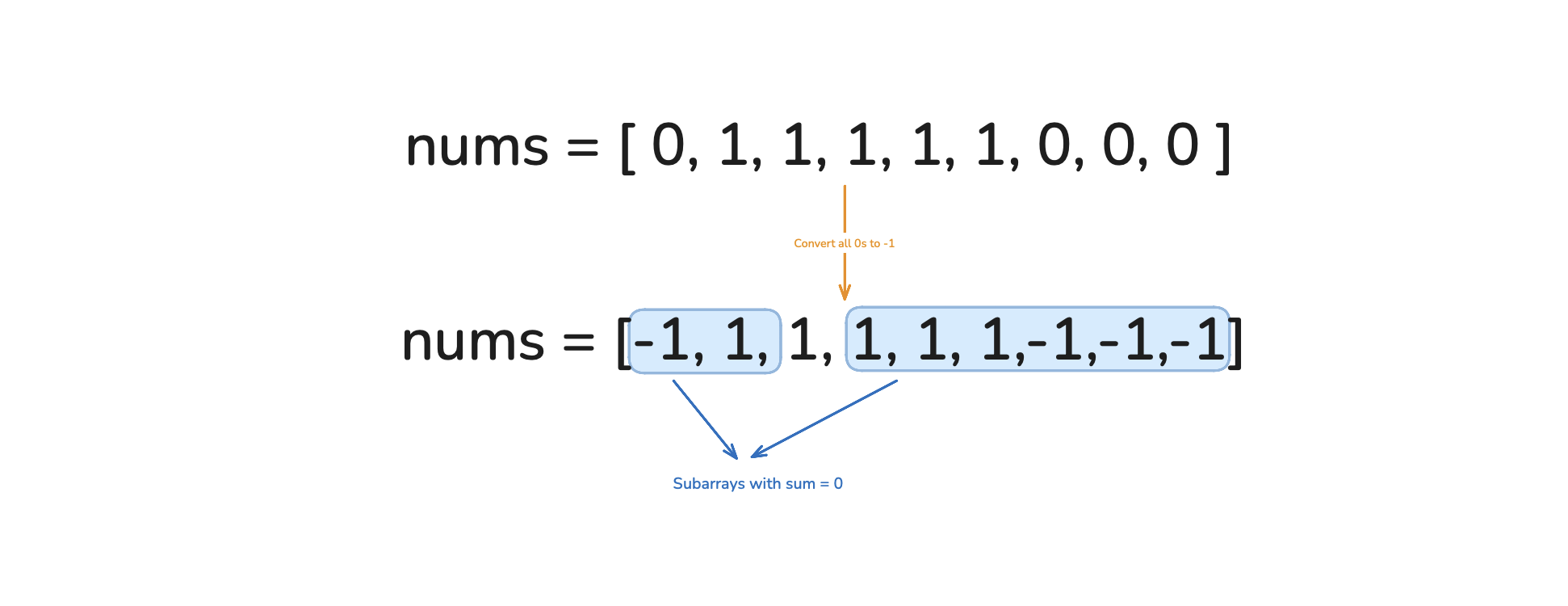
Instead of separately counting 0s and 1s for every possible subarray, we can convert all 0s to -1.
- A subarray with equal number of
0s and1s will have a sum of0. Therefore, the problem becomes: "Find the longest contiguous subarray whose sum is0".
- If a subarray
(i + 1 ... j)has a sum of0, thenprefixSum[j] - prefixSum[i] = 0, which meansprefixSum[i] = prefixSum[j]. Therefore, while iterating, whenever a prefix sum is encountered again, the elements between its first occurrence and the current index have a sum of0.
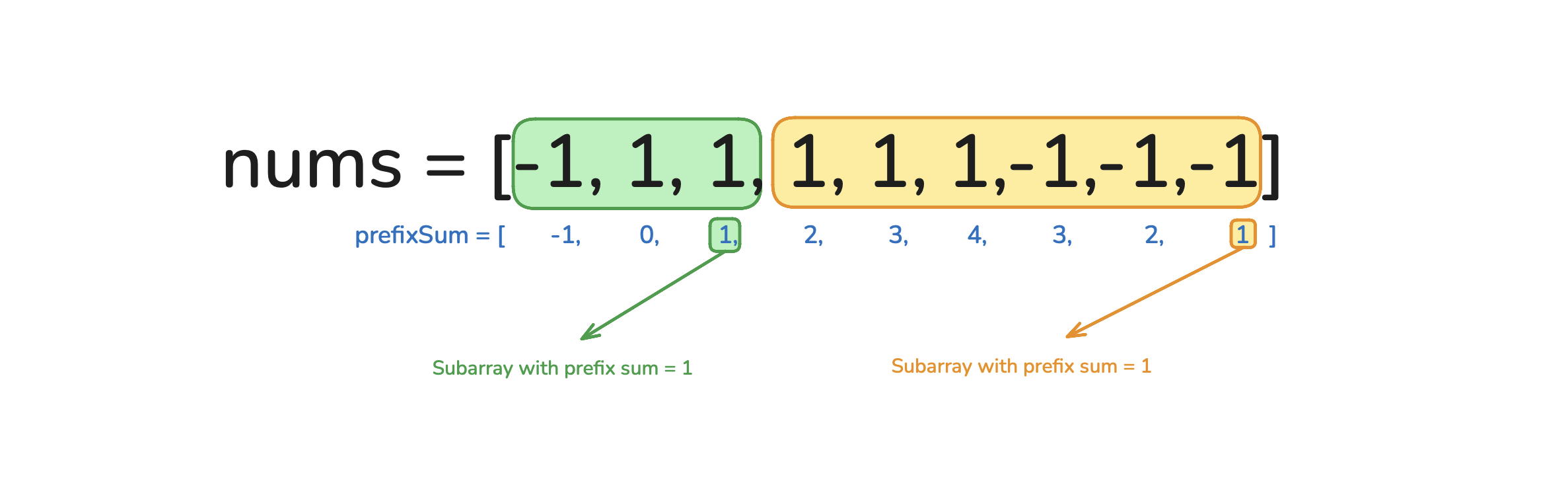
Hence, the problem can be reduced to checking whether a prefix sum has been observed before and, if so, calculating the length of the subarray between the two occurrences.
Suitable Approach - Prefix Sum
Create a dummy array where every 0 is replaced with -1. Iterate over nums and maintain a map to store
each prefix sum and its first occurrence.
While iterating, if we encounter a prefix sum that has been seen before, we have found an eligible subarray
whose sum is 0, meaning the subarray contains an equal number of 0s and 1s.
- Instead of creating a separate array, convert
0to-1directly while calculating the prefix sum, avoiding extra space. - Add
{0: -1}to the map to handle subarrays that start at index0and have a sum of0.
Algorithm
1. Initialize:
    a. A variable: "maxLength" to track the length of the longest subarray with equal
       number of 0s and 1s.
    b. A variable: "currentPrefixSum" to track the prefix sum observed so far.
    c. A map: "currentPrefixSumMap" to track the first occurrence of each distinct prefix sum.

2. Add "{0: -1}" to "currentPrefixSumMap" handle subarrays starting at index 0.

3. Iterate over each "index" in "nums":
    4. If the current element is 1, add 1 to "currentPrefixSum".
    5. If the current element is equal 0, add -1 to "currentPrefixSum".
    6. If "currentPrefixSum" exists in "currentPrefixSumMap", update "maxLength" if necessary.
    7. If "currentPrefixSum" does not exist in "currentPrefixSumMap", add "currentPrefixSum"
       and "index" as key-value pair.

8. Return "maxLength".
Implementation
Time Complexity
Each iteration involves basic validation and arithmetic operations, each taking constant time, O(1).
Therefore, the time complexity still primarily depends on the total number of iterations.
The loop runs n times. Hence, the overall time complexity is O(n).
Space Complexity
We maintain a map to store the first occurrence of each distinct prefix sum. In the worst case,
when all elements in nums are 1, the map will store n distinct prefix sums. Hence, the overall
space complexity is O(n).