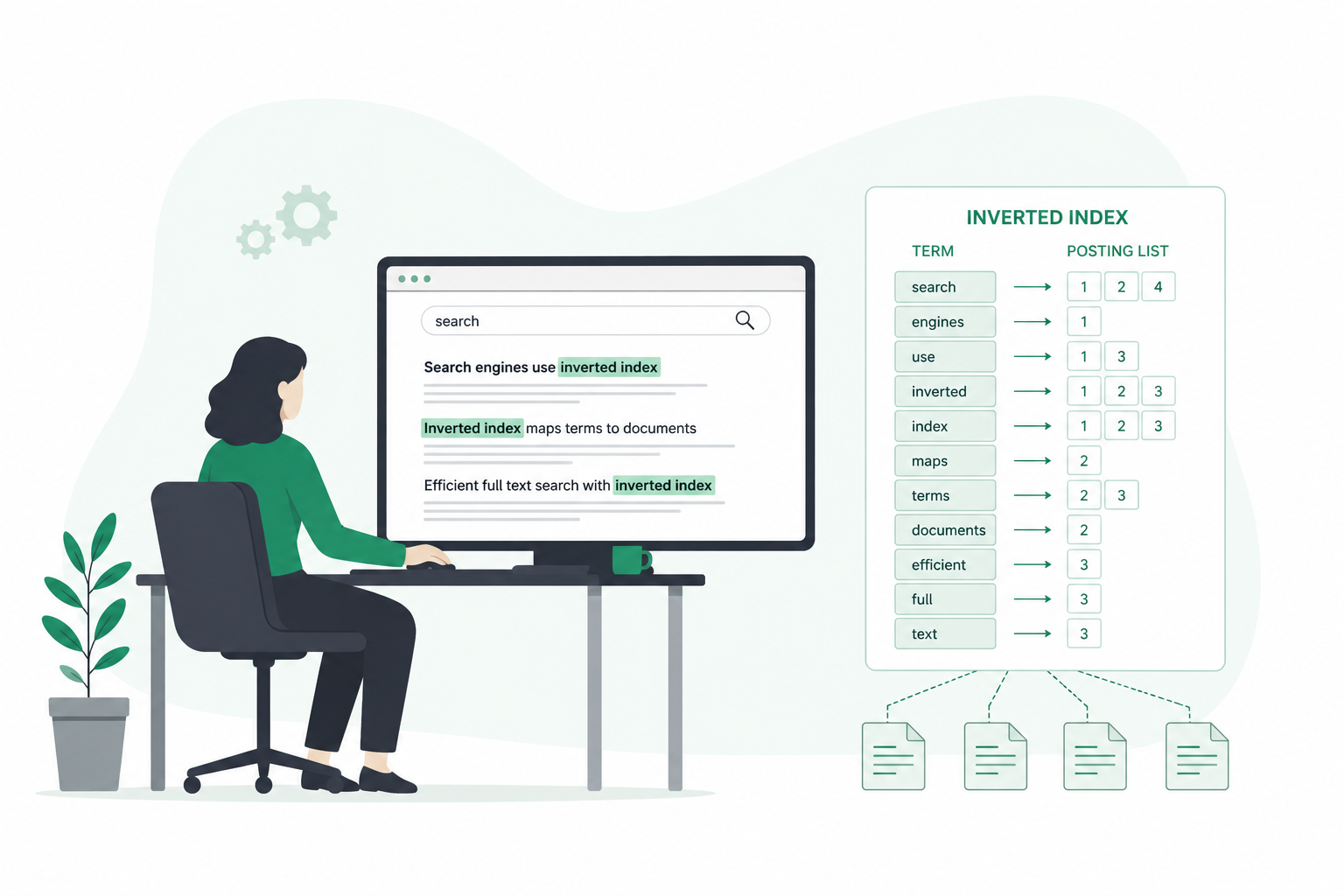
An inverted index lets us quickly which documents contain a particular word, instead of scanning every document.
Functional Requirements
-
addDocument(document): -
search(term): Returns a list of document IDs that contain the term.
Design Rationale
Q. What should be the primary data structure for storing "term" -> "document IDs" mapping?
Naive Approach
Use Map<String, Set<DocumentId>> to store the mapping. For example:
{
    "the"   → {1, 2, 3},
    "quick" → {1},
    "brown" → {1, 2},
    "fox"   → {1, 3},
    "dog"   → {2},
    "jumps" → {3},
    ...
}
But Set<DocumentId> is not efficient for searching. Consider:
Document 1:
"fox fox fox jumps"
Our index would only store "fox" -> {1} and "jumps" -> {1}. But we don't know how many times "fox"
appears in Document 1, whether two words appear close together, etc. For search ranking and phrase queries,
this information matters.
Better Approach
Introduce a Posting to store a particular term's occurrence inside one document. For example:
Document 1:
"The quick brown fox"

The posting for fox could be:

Posting
----------------
documentId = 1
frequency  = 1
positions   = [3]

Document 2:
"fox jumps over fox"

Posting
----------------
documentId = 2
frequency  = 2
positions   = [0, 3]
So:
class Posting {
    long documentId;
    int frequency;
    List<Integer> positions;
}
Now one term can occur in many documents. For example:
fox
 ↓
PostingList

Posting(documentId=1, frequency=1, positions=[3])
Posting(documentId=2, frequency=2, positions=[0,3])
Posting(documentId=7, frequency=1, positions=[5])
So:
class PostingList {
    List<Posting> postings;
}
Q. What is the need of a Tokenizer?
Before putting content into the index, we need to break the document into terms (why?).
"The quick brown fox"
          ↓
["the", "quick", "brown", "fox"]
So we create an abstraction (explain the reason behind using an abstraction):
interface Tokenizer {
    List<String> tokenize(String text);
}
Implementation:
class SimpleTokenizer implements Tokenizer {

    @Override
    public List<String> tokenize(String text) {
        return Arrays.stream(
                text.toLowerCase().split("\\W+")
        ).toList();
    }
}
Now the responsibilities are separated:
Document
    ↓
Tokenizer
    ↓
terms
    ↓
InvertedIndex
Object-Model Design
InvertedIndex Class
Now the central class becomes:
class InvertedIndex {

    private final Map<String, PostingList> index;

    public void add(Document document) {
        // ...
    }

    public PostingList search(String term) {
        // ...
    }
}
Mental Model:
                         InvertedIndex
                              │
                    Map<String, PostingList>
                              │
          ┌───────────────────┼───────────────────┐
          ↓                   ↓                   ↓
        "fox"              "brown"             "dog"
          │                   │                   │
          ↓                   ↓                   ↓
    PostingList         PostingList         PostingList
      │    │              │    │              │
      ↓    ↓              ↓    ↓              ↓
     P1    P2             P1    P2             P2
Document Class
class Document {

    private final long id;
    private final String content;

    public Document(long id, String content) {
        this.id = id;
        this.content = content;
    }

    public long getId() {
        return id;
    }

    public String getContent() {
        return content;
    }
}
Low Level Implementation
Adding a document
add(document)
     │
     ↓
Tokenizer
     │
     ↓
["the", "quick", "brown", "fox"]
     │
     ↓
For each term
     │
     ↓
Update PostingList
Follow-up Questions
Q. How to support AND queries?
For:
quick AND fox
we calculate:
{1,4,7}
       ∩
{1,3,7}

= {1,7}
So we need a query layer.
class SearchEngine {

    private final InvertedIndex index;

    public List<Document> search(String query) {
        // parse query
        // retrieve posting lists
        // combine postings
        // rank results
    }
}
The inverted index should primarily be responsible for indexing and retrieving postings. Query interpretation and ranking can be separate responsibilities.