Given an integer array nums, find the subarray with the largest sum, and return its sum.
Example 1:

Input: nums = [-2,1,-3,4,-1,2,1,-5,4]
Output: 6
Explanation: The subarray [4,-1,2,1] has the largest sum 6.

Example 2:

Input: nums = [1]
Output: 1
Explanation: The subarray [1] has the largest sum 1.

Example 3:

Input: nums = [5,4,-1,7,8]
Output: 23
Explanation: The subarray [5,4,-1,7,8] has the largest sum 23.
Playground: Leetcode 53
Nested Loops Approach (Brute Force)
Use two nested loops to iterate over all possible subarrays, compute their sums incrementally, and keep track of maximum sum found.
Visualization
Algorithm
public int maxSubArray(int[] nums) {
    int maxSum = Integer.MIN_VALUE;

    for(int i = 0; i < nums.length; i++) {
        int currentSum = 0;
        for(int j = i; j < nums.length; j++) {
            currentSum += nums[j];
            maxSum = Math.max(maxSum, currentSum);
        }
    }

    return maxSum;
}
Time Complexity
For each start index i, the inner loop runs from i to n - 1.
That yields n + (n - 1) + (n - 2) + ... + 1 iterations, which simplifies to n(n + 1) / 2.
Ignoring constants and lower-order terms, the overall time complexity = O(n²).
Space Complexity
We only use a few scalar variables such as maxSum, currentSum, i, and j.
Since, only constant extra space is used, the overall space complexity = O(1).
Key Observation
At any index = i, if the previous subarray sum is negative, carrying it forward only
reduces your current sum.
For example, in [-2, 1], it's better to start a new subarray at
index = 1 (i.e., [1]) rather than expanding the previous array (i.e., [-2]) to [-2, 1].
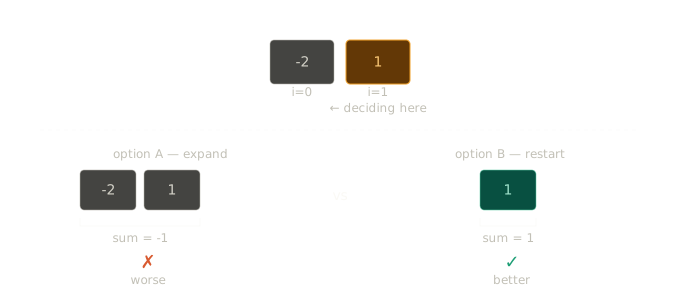
NOTE: At every index, you decide: "Should I start a new subarray from here, or continue expanding the previous one?"
Kadane's Algorithm
Iterate through the nums array, updating the current subarray sum by choosing between expanding
the previous subarray or starting a new one, while keeping track of the maximum sum found.
Visualization
Algorithm
public int maxSubArray(int[] nums) {
    int maxSum = nums[0];
    int currentSum = nums[0];

    for(int i = 1; i < nums.length; i++) {
        currentSum = Math.max(nums[i], currentSum + nums[i]);
        maxSum = Math.max(maxSum, currentSum);
    }

    return maxSum;
}
Time Complexity
We are only iterating through the nums array once. Considering the operations performed
inside each iteration take constant time, the overall time complexity = O(n).
Space Complexity
Consideing no extra space is used, the overall space complexity = O(1).