Given a binary array nums (containing only 0s and 1s) and an integer k, return
the minimum numbers of adjacent swaps required so that nums has k consecutive 1s.
Example 1:

Input: nums = [1,0,0,1,0,1], k = 2
Output: 1
Explanation: We can swap the 1 at index 3 with the 0 at index 4 to get [1,0,0,0,1,1] and
have 2 consecutive 1's.

Example 2:

Input: nums = [1,1,0,1], k = 2
Output:0
Explanation: nums already has 2 consecutive 1's.
Solve Here: Leetcode 1703
Intuition
For adjacent swaps, the optimal strategy is to select a 1 and move all the remaining (k-1)
1s around it, keeping the relative order of the selected k 1s intact.
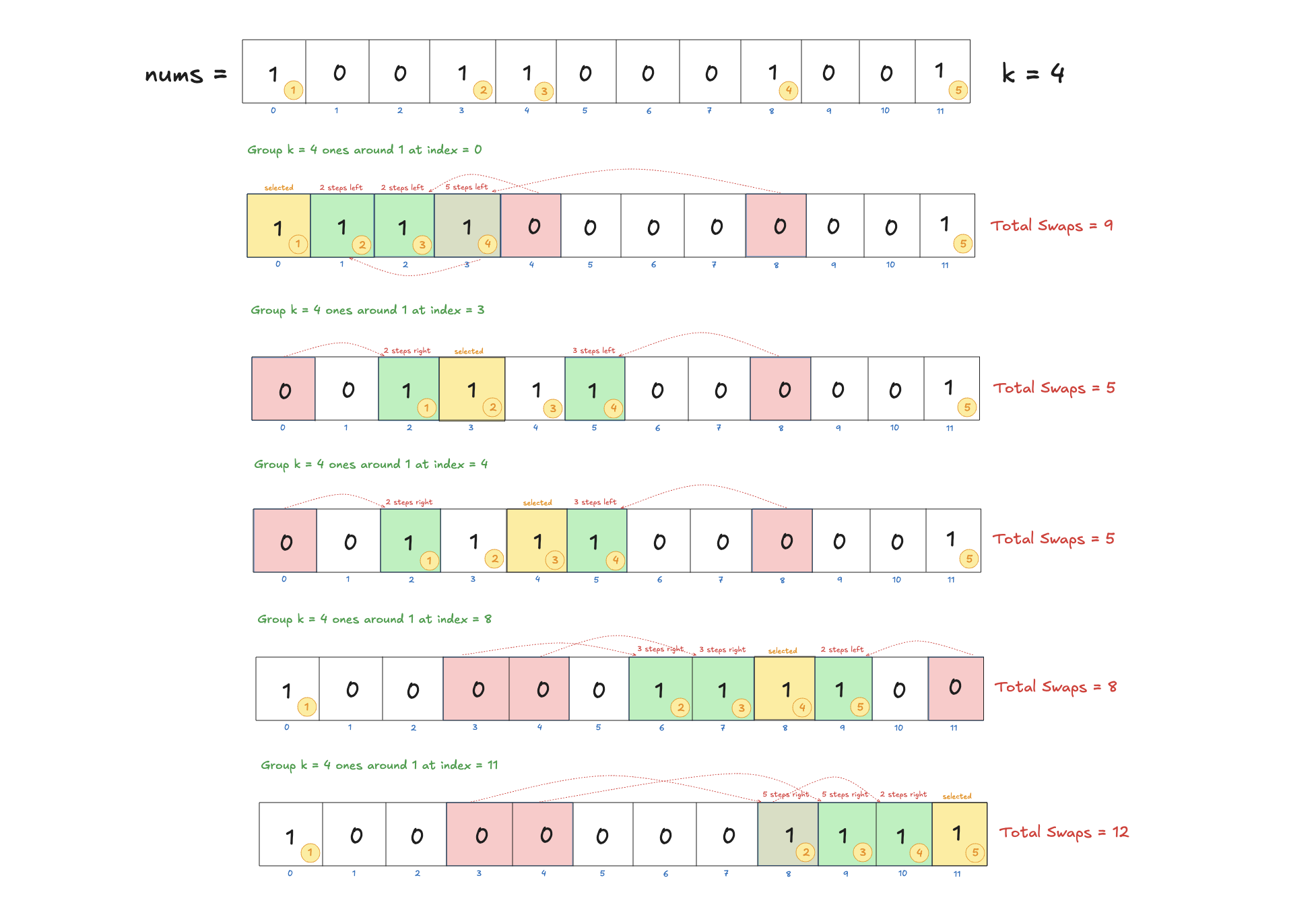
The primary challenge is to determine which k ones to group together and where they
should be placed so that the total number of adjacent swaps is minimized.
Trick: Move Towards Median Position
When we want to group k ones together into consecutive positions, the best way is
to move them towards their median position. For example, if we have ones at positions
[0, 3, 4, 8], moving them to positions around 4 (the median) like [2, 3, 4, 5]
requires fewer moves than moving them to positions around 0 or 8.
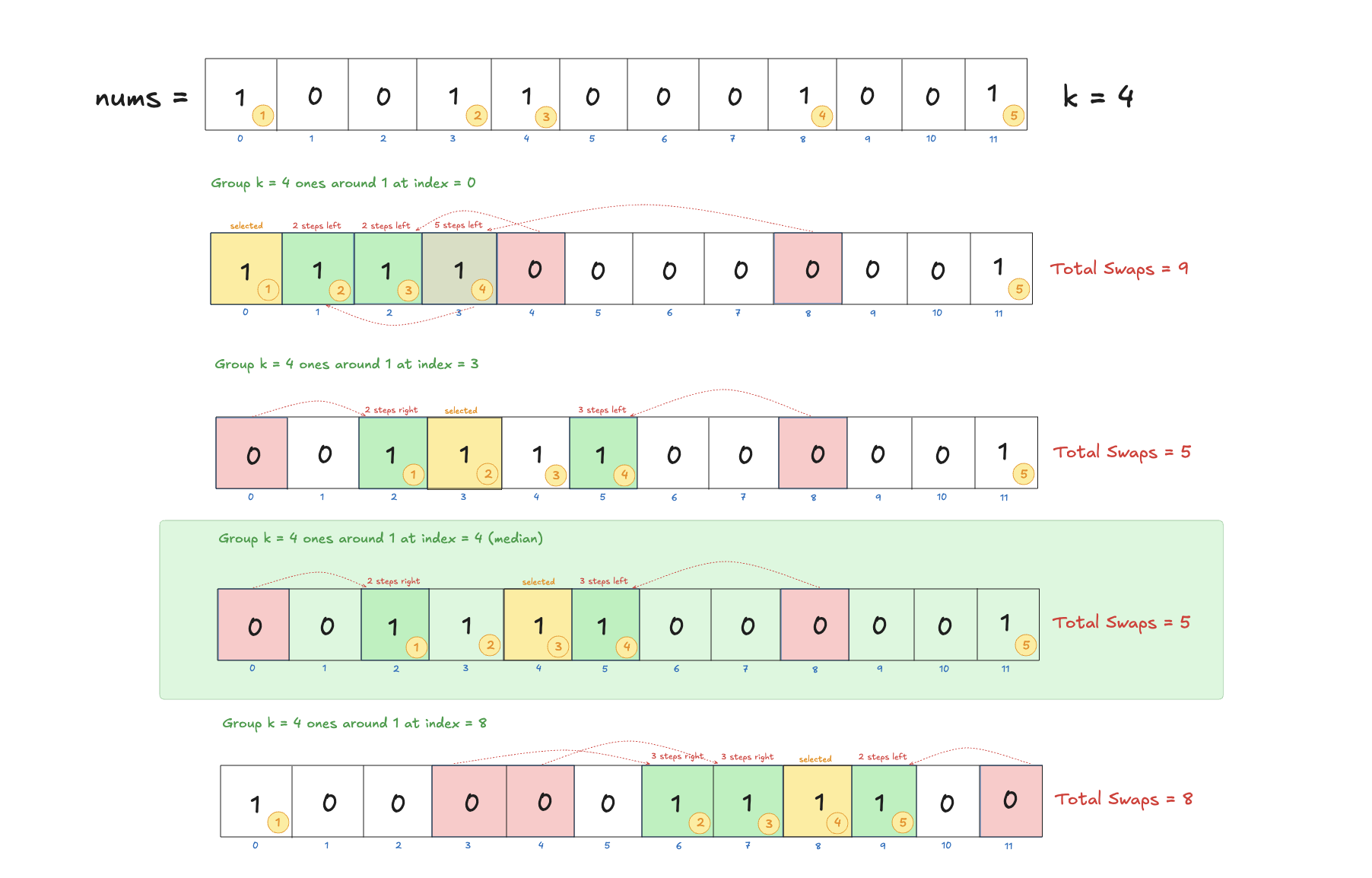
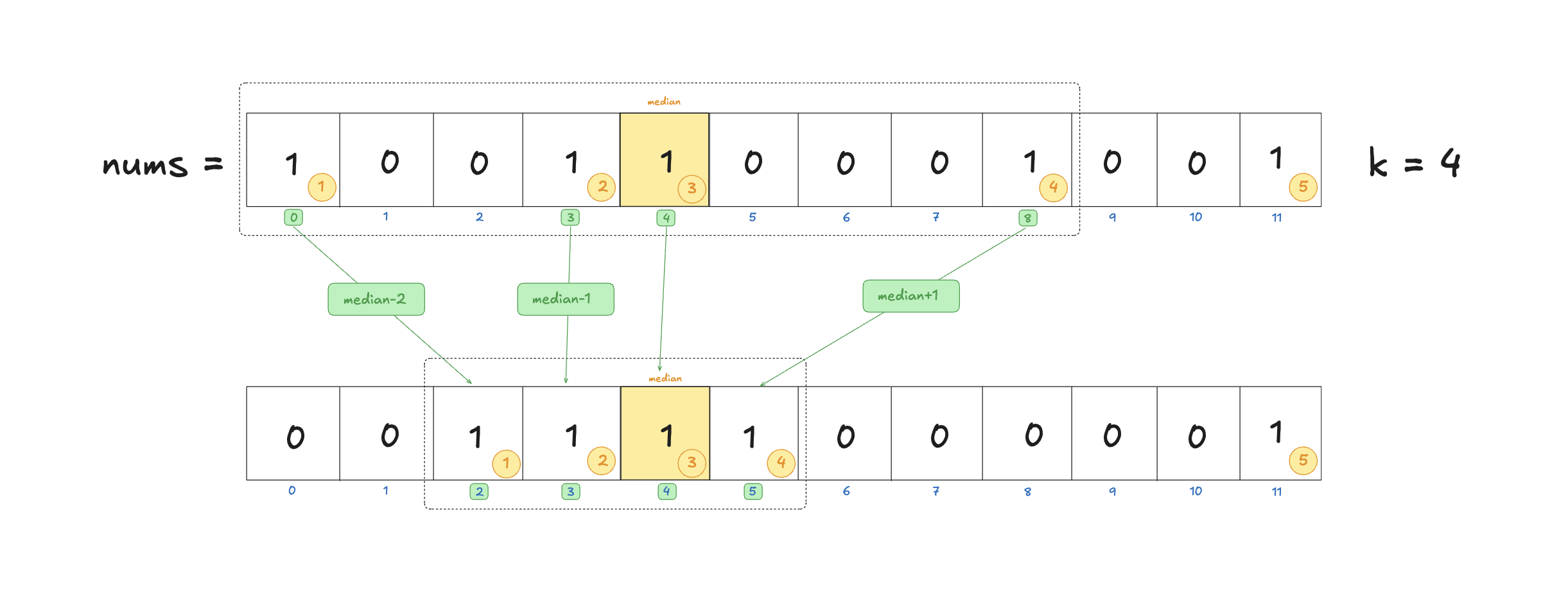
NOTE: The ones to the left of the median need to move to positions
[median-x, ..., median-2, median-1]and the ones to the right need to move to positions[median+1, median+2, ..., median+y].
Approach 1: Sliding Window
We are only conerned with the positions of 1s, so, we can first store the indices of all
1s in a pos list and then use a sliding window of size k to iterate through all possible
groups of k ones.
For each group, we find the median position and calculate the minimum number of adjacent
swaps required to move all selected 1s into consecutive positions centered around the
median while preserving their relative order.
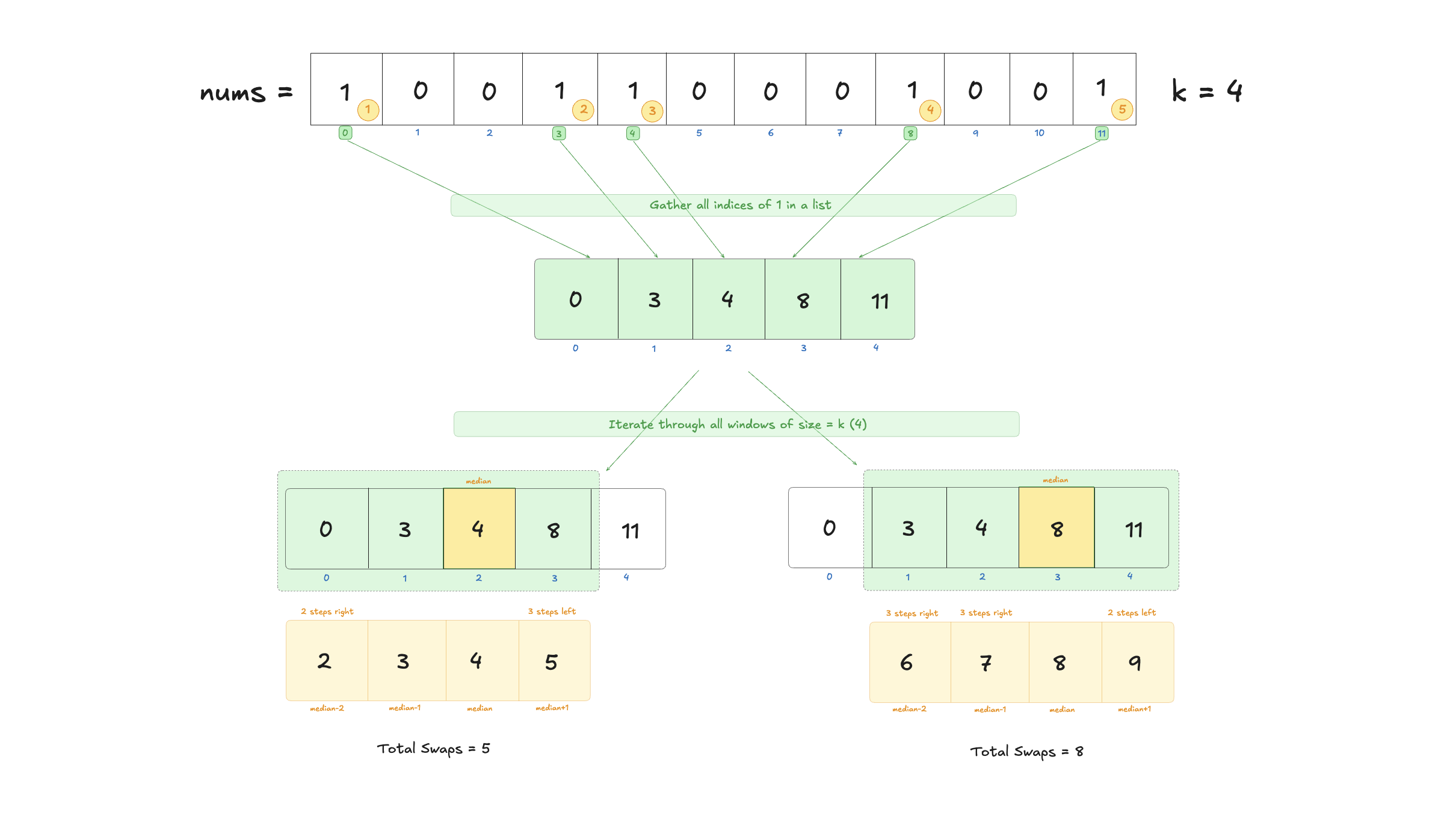
NOTE: If
midis the index of the median in the group, then the target position for any1rankediin the window should land at:target(i) = pos[mid] - (mid - i).
Algorithm
public int minMoves(int[] nums, int k) {

    List<Integer> pos = new ArrayList<>();

    // Store positions of all 1s
    for (int i = 0; i < nums.length; i++) {
        if (nums[i] == 1) {
            pos.add(i);
        }
    }

    int answer = Integer.MAX_VALUE;

    // Try every possible group of k 1s
    for (int start = 0; start + k - 1 < pos.size(); start++) {

        int end = start + k - 1;
        int mid = start + (k / 2);
        int medianPos = pos.get(mid);

        /*
            Calculate the number of moves required to
            move all 1s in the group to consecutive positions
            centered around the median.
        */
        int swaps = 0;
        for (int i = start; i <= end; i++) {
            int target = medianPos - (mid - i);
            swaps += Math.abs(pos.get(i) - target);
        }

        answer = Math.min(answer, swaps);

    }

    return answer;

}
Optimization
We are only interested in calculating the number of swaps required to group all 1s in a window, not their exact target positions. The swap calculation logic can be rewritten as:
target[i] = pos[mid] - (mid - i)

swap[i]   = |pos[i] - target[i]|
          = |pos[i] - (pos[mid] - (mid - i))|
          = |(pos[i] - i) - (pos[mid] - mid)|
We can precompute (adjustedPos[i] = pos[i] - i) for all indices i in the window to simplify
the swap calculation.
NOTE: The median depends on the relative ordering of elements, not their actual values. Since the transformation
(adjusted[i] = pos[i] - i)preserves the ordering of elements, the median index remains unchanged after the transformation.
public int minMoves(int[] nums, int k) {

    ...

    // Precompute pos[i] - i for all indices i in the window
    int[] adjustedPos = new int[pos.size()];
    for (int i = 0; i < pos.size(); i++) {
        adjustedPos[i] = pos.get(i) - i;
    }

    int answer = Integer.MAX_VALUE;

    // Try every possible group of k 1s
    for (int start = 0; start + k - 1 < pos.size(); start++) {

        ...

        int swaps = 0;
        for (int i = start; i <= end; i++) {
            swaps += Math.abs(adjusted[i] - medianPos);
        }

        ...

    }

    ...

}
Time Complexity
We iterate over nums of length n once to store all positions of 1s in the pos list.
If there are m 1s in the array, the number of possible windows of size k is m - k + 1.
For each window, we are looping through k elements to calculate the number of swaps required
to group all 1s in the window into consecutive positions centered around the median.
In the worst case, the array contains all 1s such that m = n. Hence, overall time
complexity = O(n) + O((n - k + 1) * k) ~ O(n * k).
Space Complexity
We are using a list to store the positions of all 1s. Hence, overall space complexity = O(m).
Approach 2: Sliding Window with Prefix Sum
The expensive part is computing total swaps for every window.
swaps = |adjusted[i] - adjusted[mid]| + |adjusted[i+1] - adjusted[mid]| + ... + |adjusted[i + k - 1] - adjusted[mid]|
For the indices to the left of the median, adjusted[i] <= medianPos, while for the indices
to the right, adjusted[i] >= medianPos.
Hence, the total swaps can be computed as:
leftCost  = (adjusted[mid] - adjusted[start]) + (adjusted[mid] - adjusted[start+1]) + ... + (adjusted[mid] - adjusted[mid-1])
          = adjusted[mid] * (mid - start) - (adjusted[start] + adjusted[start+1] + ... + adjusted[mid-1])

RightCost = (adjusted[mid+1] - adjusted[mid]) + (adjusted[mid+2] - adjusted[mid]) + ... + (adjusted[i + k - 1] - adjusted[mid])
          = (adjusted[mid+1] + adjusted[mid+2] + ... + adjusted[i + k - 1]) - adjusted[mid] * (i + k - 1 - mid)

swaps = leftCost + rightCost
Instead of iterating over the window to calculate the total swaps, we can precompute the
prefix sum of adjusted array and use it to calculate the left and right movement costs
in O(1).
leftCost  = (adjusted[mid] - adjusted[start]) + (adjusted[mid] - adjusted[start+1]) + ... + (adjusted[mid] - adjusted[mid-1])
          = adjusted[mid] * (mid - start) - (adjusted[start] + adjusted[start+1] + ... + adjusted[mid-1])
          = adjusted[mid] * (mid - start) - (prefix[mid] - prefix[start])

RightCost = (adjusted[mid+1] - adjusted[mid]) + (adjusted[mid+2] - adjusted[mid]) + ... + (adjusted[i + k - 1] - adjusted[mid])
          = (adjusted[mid+1] + adjusted[mid+2] + ... + adjusted[i + k - 1]) - adjusted[mid] * (i + k - 1 - mid)
          = (prefix[i + k] - prefix[mid + 1]) - adjusted[mid] * (i + k - 1 - mid)
Algorithm
public int minMoves(int[] nums, int k) {

    List<Integer> pos = new ArrayList<>();

    // Store positions of all 1s
    for (int i = 0; i < nums.length; i++) {
        if (nums[i] == 1) {
            pos.add(i);
        }
    }

    // Compute adjusted positions
    int[] adjustedPos = new int[pos.size()];
    for (int i = 0; i < pos.size(); i++) {
        adjustedPos[i] = pos.get(i) - i;
    }

    // Prefix Sums
    int[] prefixSum = new int[pos.size() + 1];
    for (int i = 0; i < pos.size(); i++) {
        prefixSum[i+1] = prefixSum[i] + adjustedPos[i];
    }

    int answer = Integer.MAX_VALUE;

    // Try every contiguous group of k ones
    for (int start = 0; start + k - 1 < pos.size(); start++) {
        int end = start + k - 1;
        int mid = start + k / 2;  // Median index
        int medianPos = adjustedPos[mid];

        int leftCost = (medianPos * (mid - start)) - (prefixSum[mid] - prefixSum[start]);
        int rightCost = (prefixSum[end+1] - prefixSum[mid+1]) - (medianPos * (end - mid));
        int swaps = leftCost + rightCost;
        answer = Math.min(answer, swaps);
    }

    return answer;

}
Time Complexity
Traverse the array to store positions of all 1s → O(n)
Build adjusted positions array → O(m)
Build prefix sum array → O(m)
Sliding window over all groups of k ones → O(m)
Since each window's swap cost is computed in O(1) using prefix sums, the overall time
complexity = O(n).
Space Complexity
We use extra space for positions array, adjusted positions array, and prefix sum array. Since,
each stores at most m elements, the overall space complexity = O(m).