Given two strings s1 and s2, return true if s2 contains a permutation of s1, or false otherwise.
Example 1:

Input: s1 = "ab", s2 = "eidbaooo"
Output: true
Explanation: s2 contains one permutation of s1 ("ba").

Example 2:

Input: s1 = "ab", s2 = "eidboaoo"
Output: false
Playground: Leetcode 567
Key Observations
All permutations of a string have the same character frequencies.
Therefore, if the frequency map of any substring of s2 having length s1.length() matches the frequency map of s1,
then that substring is a valid permutation of s1, and s2 contains a permutation of s1.
Naive Approach - Nested Loops
Iterate over every substring of s2 having length s1.length(). For each substring, compare its frequency map with the
frequency map of s1.
Algorithm
1. Create a frequency map: "targetFrequencyMap" for "s1".

2. Iterate over each valid starting index in "s2", treating each index as the starting
   position of the current substring.
    3. Initialize a frequency map: "currentSubstringFrequencyMap" for the current substring.
    4. Iterate over the next "s1.length()" characters in "s2" and update
       "currentSubstringFrequencyMap".
    5. If "currentSubstringFrequencyMap" == "targetFrequencyMap", return true.

6. If no eligible substring was found, return false.
Implementation
Time Complexity
The primary operations in the inner loop involve adding entries to currentSubstringFrequencyMap
and checking if it makes targetFrequencyMap. Considering both operations take constant
amount of time, O(1), the time complexity is dependent on the number of iterations of the
inner and outer loops.
The outer loop runs (n - m + 1) times, where n = s2.length() and m = s1.length(). For
each outer loop iteration, the inner loop runs is executed m times.
Therfore, the overall time complexity is O((n - m + 1) x m) ~ O(n x m).
Space Complexity
Both currentSubstringFrequencyMap and targetFrequencyMap can store the frequencies of
upto m distinct characters simultaneously, where m = s1.length().
Therefore, the overall space complexity is O(m).
Key Optimizations
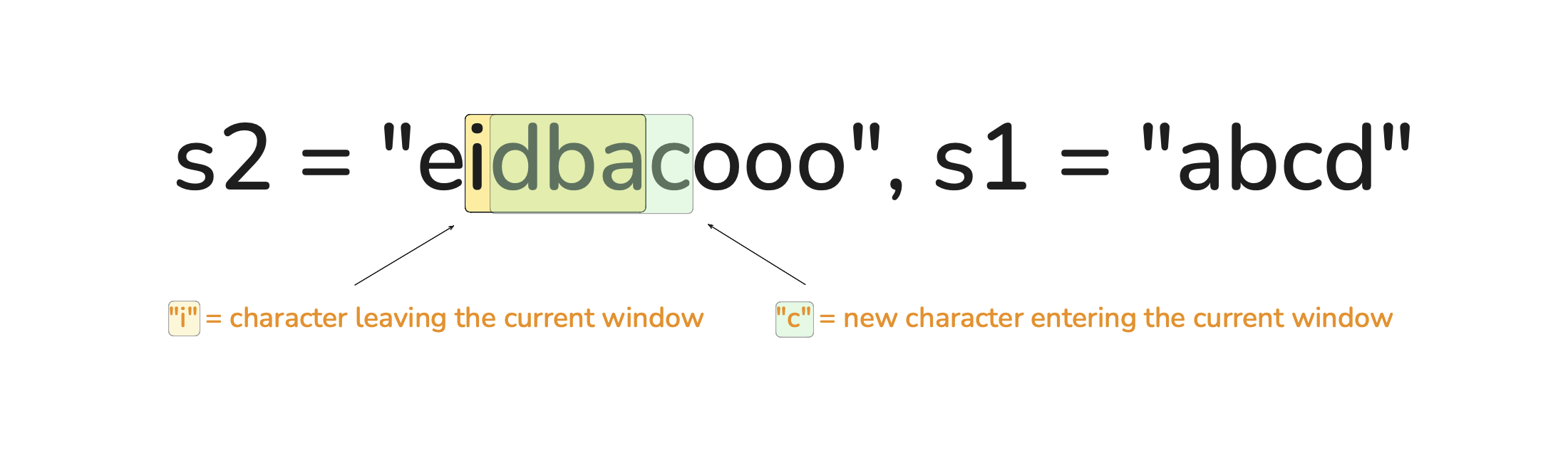
For each outer loop iteration, only one new character enters the current substring, while the remaining characters have already processed in the previous iteration.
Suitable Approach - Sliding Window
Instead of rebuilding currentSubstringFrequencyMap for every substring, maintain
a fixed-size sliding window of length m = s1.length().
As the window slides, add the frequency of the new character entering the window and
decrement the frequency of character leaving the window. This allows us to update the
currentSubstringFrequencyMap in O(1) time for each window, rather than rebuilding
it in O(m) time.
Algorithm
1. Create a frequency map: "targetFrequencyMap" for "s1".

2. Initialize:
    a. Two pointers: "left = 0" and "right = 0" to represent the boundaries of the current window.
    b. A frequency map: "currentSubstringFrequencyMap" for the current window.

3. Increment the "right" pointer to expand the current window one character at a time:
    4. Add the frequency of the new character: "s2[right]" to "currentSubstringFrequencyMap".

    5. If the current window size is greater than "s1.length()":
        6. Remove the frequency of character: "s[left]" from "currentSubstringFrequencyMap".
        7. Increment "left" to remove the character: "s[left]" from the current window.

    8. If "currentSubstringFrequencyMap" == "targetFrequencyMap", return true.

9. If no eligible substring was found, return false.
Implementation
Time Complexity
The add, update and removal operations performed in each iteration take constant
time, O(1), on average. The time complexity is only dependent on the movement of
left and right pointers.
The right pointer traverses all n character in s2 once. The left pointer
traverses at most n - m characters.
Therefore, the total number of pointer movements is at most n + (n - m), which
is bounded by 2n. Since constant factors are ignored in Big-O notation, the overall
time complexity is O(n).
Space Complexity
Both the currentSubstringFrequencyMap and targetFrequencyMap can hold at most
m distinct characters simultaneously.
Therefore, the overall space complexity is still O(m).